⚙️ L298N Motor Driver
🎯 Lesson Objective
In this lesson, students will understand:
• What a motor driver is
• Why a motor driver is required in robotics systems
• What the L298N motor driver module is
• The main components and pins of the L298N module
• How the L298N motor driver controls DC motors
This lesson introduces an essential component used to control motors safely in robotics projects.
1️⃣ Why a Motor Driver is Needed
In robotics systems, the microcontroller is responsible for controlling motors. However, motors require more power than the microcontroller can provide directly.
For example:
• The ESP32 operates at 3.3V logic level
• The GPIO pins provide very small current
DC motors require higher current and sometimes higher voltage to operate properly.
If we connect a motor directly to the ESP32:
⚠ The motor may not run properly
⚠ The microcontroller may get damaged due to high current
To solve this problem, we use a motor driver module.
A motor driver acts as a bridge between the microcontroller and the motor, allowing the microcontroller to control high-power motors safely.
2️⃣ What is the L298N Motor Driver?
The L298N motor driver module is a widely used motor control module designed to control DC motors and stepper motors.
It is capable of controlling two DC motors at the same time, making it ideal for mobile robots.
The L298N motor driver allows the microcontroller to control:
⚙ Motor direction (forward or reverse)
⚡ Motor speed
🔄 Motor start and stop
Because of these features, the L298N module is commonly used in robotics projects such as:
• Line follower robots
• Obstacle avoiding robots
• Bluetooth-controlled robots
• Autonomous robots
3️⃣ Understanding the H-Bridge Concept
The L298N motor driver works based on a circuit configuration called an H-Bridge.
An H-Bridge is an electronic circuit that allows the direction of current through a motor to be reversed.
By reversing the current flow, the motor can rotate in either direction.
This allows the robot to:
🔄 Move forward
🔁 Move backward
↩ Turn left
↪ Turn right
The H-Bridge is one of the most important concepts in motor control systems.
4️⃣ Main Parts of the L298N Module
The L298N module contains several components that help control motors.
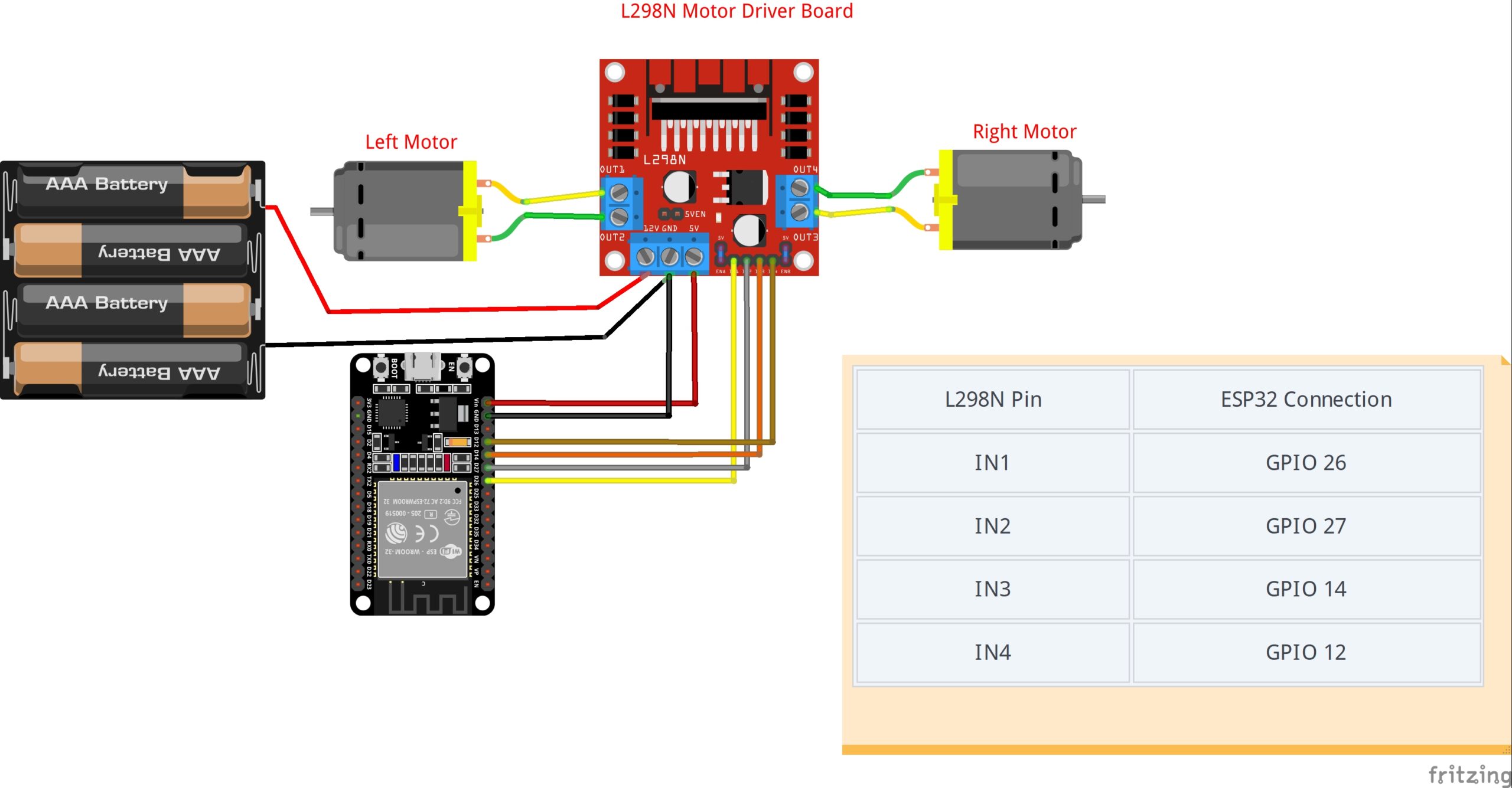
🔌 Power Input
The motor driver requires an external power supply for the motors.
This power is usually provided by a battery pack.
⚙ Motor Output Terminals
The module contains two motor output channels.
These terminals connect to the DC motors of the robot.
Usually labeled as:
Motor A
Motor B
Each channel controls one motor.
🔗 Control Pins
The motor driver receives control signals from the microcontroller.
Common control pins include:
IN1
IN2
IN3
IN4
These pins control the direction of each motor.
🎚 Enable Pins
Enable pins control whether the motor driver outputs power to the motors.
These pins can also be used to control motor speed using PWM signals.
5️⃣ How the L298N Controls Motor Direction
The motor driver changes the direction of the motor depending on the signals received from the microcontroller.
For example:
| IN1 | IN2 | Motor Action |
|---|---|---|
| HIGH | LOW | Motor rotates forward |
| LOW | HIGH | Motor rotates backward |
| LOW | LOW | Motor stops |
| HIGH | HIGH | Motor stops |
By controlling these input signals, the microcontroller can determine how the robot moves.
6️⃣ L298N in Robotics Projects
In robotics systems, the motor driver plays an important role in controlling robot movement.
The process works as follows:
1️⃣ The ESP32 sends signals to the motor driver.
2️⃣ The motor driver receives the signals.
3️⃣ The motor driver controls the power supplied to the motors.
4️⃣ The motors rotate and move the robot.
Without the motor driver, the microcontroller would not be able to safely control the motors.
7️⃣ Why L298N is Popular in Robotics
The L298N motor driver is widely used in robotics because it offers several advantages:
✔ Can control two motors simultaneously
✔ Supports motor direction control
✔ Allows speed control using PWM
✔ Easy to connect and use
✔ Widely available and affordable
These features make it an excellent choice for beginners learning robotics.
🚀 What Happens Next
Now that you understand how the motor driver allows the microcontroller to control motors safely, the next step is to learn about a sensor that helps robots detect distance and obstacles.